














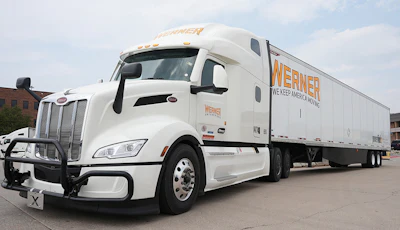
Werner (CCJ Top 250, No. 14) reported improved first quarter results, driven from pricing gains, FirstFleet acquisition and restructuring its one-way truckload fleet.
[RELATED: Will Werner's $245M FirstFleet buy signal new era of dedicated trucking consolidation?]
The Omaha-based carrier posted a net loss of attributable to itself of $4.26 million, compared with a loss of $10.1 million in the same period last year. Total revenues were up 14% from $712 million in the first quarter 2025 to $808.6 million.
“We believe Werner is better positioned today than we have been in prior cycles,” said Derek Leathers, chairman and CEO, in earnings call with analysts. “We have used this downturn to make the business more resilient.”
Werner’s Truckload Transportation Services contributed to revenue growth, with posted revenues of $594.3 million, up 18% year over year. Operating income reached $13.9 million, compared to a $0.9 million operating loss in the prior year.
The carrier closed on the acquisition of FirstFleet in January this year. As a result, dedicated’s average trucks in service grew 32.4% year over year, and the dedicated quarter-end fleet size was up 46.4%, with dedicated trucks now totaling 7,080, or 78% of the total TTS segment fleet.
FirstFleet's integration is “ahead of schedule,” Leathers said, with more than $1 million in savings and customer renewal rates at 98% for two-thirds of the portfolio.
Restructuring of the one-way truckload business, also part of the TTS segment, also paid off. It was designed to “enhance profitability by maximizing production and mitigating unprofitable freight,” Leathers reminded.
Revenues per truck climbed 9.6% from restructuring efforts over the last two quarters, along with higher spot and contractual rate increases. Revenues per total mile, net of fuel surcharge, improved 3.6% year over year, while average miles per truck per week were up 5.7%. However, the one-way fleet shrank—average trucks in service fell 19.4% to 2,122, with total trucks at quarter end down 24.8% to 1,960.

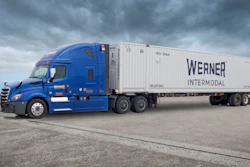
Meanwhile, logistics revenues were essentially flat, though intermodal offered a bright spot. Intermodal revenues, which represents 17% of Werner Logistics revenue, were up 18%, driven by 22% more shipments.
Get 80 tips to boost your fuel efficiency
Is the freight recovery taking shape?
Like J.B. Hunt’s (No. 5) view of a supply-driven freight recovery, Werner similarly described the recovery as being led by supply dynamics rather than demand growth.
“So far, the recovery in rates has been largely supply-driven as capacity continues to exit at an accelerate pace due to regulatory enforcement,” said Leathers. “As the supply and demand dynamic tightens, we are seeing rate lift and early positive momentum in the bid season.”
Leathers pointed to regulatory enforcement and carrier bankruptcies as the primary driver of capacity exits, which he says will continue to accelerate. Higher fuel prices are now additional recent headwinds for carriers, he added, along with long-haul truckload employment that has fallen below pre-COVID levels.
Spot rates also showed strength heading into and through first quarter. Leathers said, “We expect seasonal improvement throughout the year as capacity attrition continues.”
[RELATED: Knight-Swift eyeing better rates in tightening market]
The crackdown accelerates
Regulatory enforcement is entering a new tech-enabled approach, beyond traditional roadside checks, Leathers pointed out. It has now evolved into a wide-ranging effort targeting schools, licensing processes, and now border enforcement around B1 cabotage violations.
[RELATED: 'No fear of taking this on': Texas CDL schools surprised by allegations]
“I see no slowdown in the enforcement actions. And if anything, there seems to be sort of a drumbeat of increased pace and increased understanding of how widespread some of the coloring outside the lines really was,” he added.
Leathers also touched on the topic of drug testing standards, as the company hair follicle tests every incoming driver, calling the method “much more accurate” and “much more long-lived” than standard urine analysis, and historically “10x more likely to show a positive.”




![Img 9401[87]](https://img.ccjdigital.com/mindful/rr/workspaces/default/uploads/2026/05/img-940187.vJq7SVGjUK.jpg?auto=format%2Ccompress&fit=crop&h=167&q=70&w=250)
